

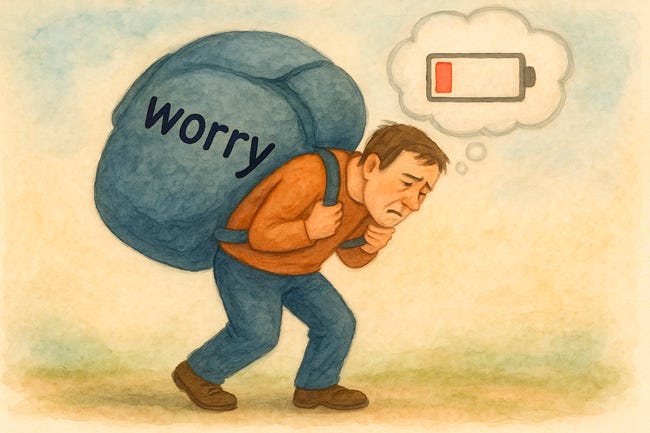
If you’re anything like me, you know what it feels like to be utterly worn out—not just physically tired, but emotionally and mentally drained. You get through the day, but by evening, your energy feels like a battery blinking red. You wonder …Why am I so exhausted when I didn’t even do that much?
Over the years, I’ve come to recognize one of the biggest culprits: Worry.
My Personal Energy Drain: Worrying About What Might Never Happen
I used to think being prepared meant thinking through every possible outcome before I made a decision. I wanted to avoid mistakes, embarrassment, or disappointment. But I now see that what I called “being prepared” was actually an exhausting mental loop of worst-case scenarios.
Instead of helping me feel more ready, it drained the energy I needed to deal with whatever actually showed up.
That’s the paradox: worry makes me feel like I’m doing something productive, when in reality, it’s stealing my clarity, confidence, and capacity to act.
When Stress Piles Up
I’ve learned that stress doesn’t just add up—it multiplies. When one stressful situation is followed by another (and another), my body eventually hits a wall.
There have been times when I didn’t even realize how overwhelmed I was until I got sick. Looking back, the signs were there:
I was tired even after a full night’s sleep.
I couldn’t concentrate on simple tasks.
I felt edgy, irritable, or numb.
I’ve come to respect those signals. They’re not weaknesses—they’re wisdom. My body speaks up when I’ve ignored my emotional bandwidth for too long.
And when I’ve reached that point, I’ve learned to ask for help. Whether it’s talking with a trusted friend, making a therapy appointment, getting acupuncture, or simply saying “no” to one more commitment, I’m learning that recovery starts with recognition.
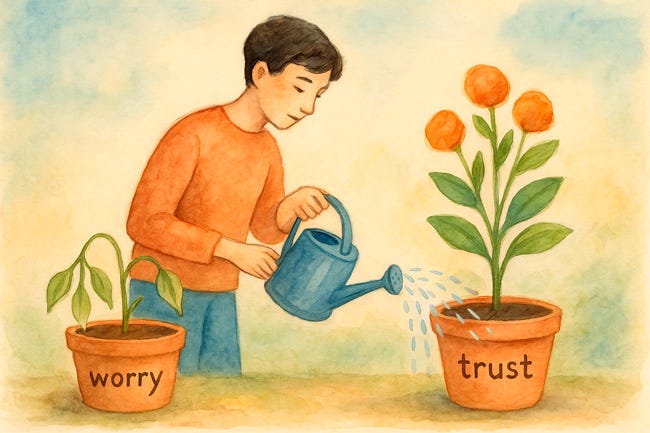
Replacing Worry with Trust
Another piece of this journey has been building quiet inner confidence. Not the kind of confidence that shouts or boasts—but the kind that whispers: You’ve been through hard things before. You can handle this, too.
Worry tries to convince me that I have to control everything in advance. Confidence reminds me that I can trust myself to meet life as it unfolds.
When I believe I can cope with whatever comes, I worry less. I stop trying to script every detail of the future and focus more on responding to the present. That shift frees up so much energy—energy I can use to create, connect, and care for myself and others in a more grounded way.
How did I build that trust? Through small, consistent acts:
Learning about my high sensitivity, introversion, social anxiety, and realizing I’m not “too much”—I’m just wired differently.
Reflecting on my life and noticing how often I’ve risen to the occasion, even when I was scared.
Reading other people’s stories and recognizing my own in them.
That’s also why I write. I hope that by sharing my experiences, you might feel less alone—and a little more hopeful.
Thoughts From Others
These quotes have stayed with me over the years. I keep them close when I feel stuck in anxious thought loops.
“Our fatigue is often caused not by work, but by worry, frustration, and resentment.” — Dale Carnegie
This is so true for me. Even on busy days, physical tasks rarely leave me as drained as a morning spent overthinking. When my thoughts are spinning, I’ve learned to get outside and move my body. This simple shift resets my nervous system and clears my mind.“If you want to test your memory, try to recall what you were worrying about one year ago today.” — E. Joseph Cossman
When I read this, I laughed—because 90% of my old worries have vanished into thin air. That’s now one of my favorite questions: Will this matter a year from now?“There is a great difference between worry and concern. A worried person sees a problem. A concerned person solves a problem.” — Harold Stephen
This helped me draw a vital line: Worry is passive. Concern is active. Worry is fueled by fear and uncertainty. Concern is grounded in a plan or a sense of acceptance. If I’m upset about something, I ask: Am I looping in fear, or taking a small, helpful action?
Questions For You
Self-reflection can act as a reducing valve when thoughts of impending doom flood your mind. Let me leave you with a few thought-provoking prompts I return to whenever I feel the energy drain setting in:
What’s been silently draining my energy lately?
Is my biggest worry something I can change, influence, or let go of?
What’s one small thing I can do to feel more grounded today?
Who can I reach out to for support—without guilt or hesitation?
What fills me back up? How can I make more space for those things?
Explore more insights on Cliff Harwin’s Highly Sensitive Thoughts Blog. Each post offers encouragement, practical wisdom, and real-life reflections to help you live with greater confidence, calm, and self-understanding.
